
Redcrab
Men’s "Fearless Ferris" Graphic Tee in Rust Red
Woen’s "Fearless Ferris" Graphic Tee in Rust Red
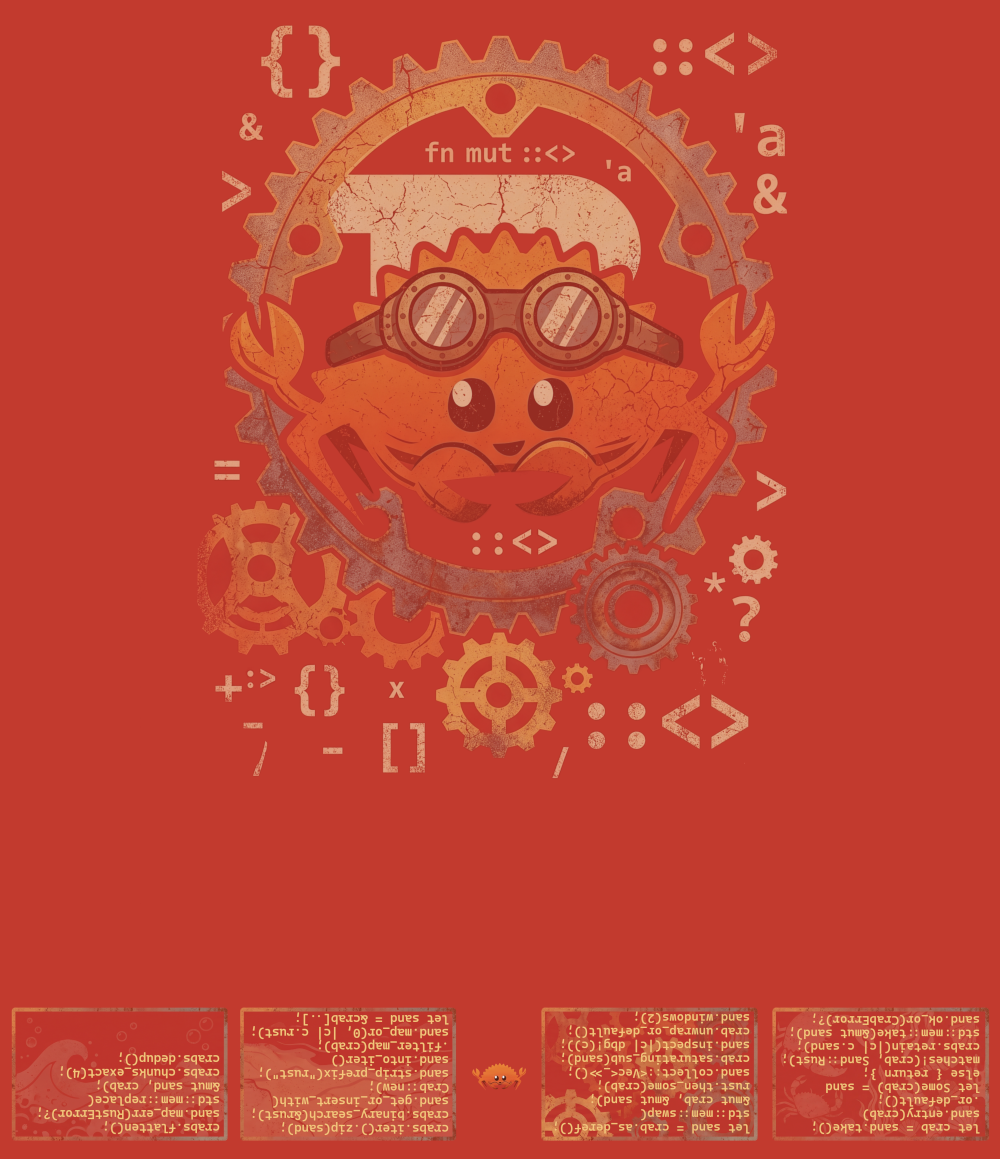
Technical Companion: "Fearless Ferris" Graphic Tee in Rust Red
Welcome to the technical breakdown of the "Fearless Ferris" Graphic Tee. This document serves as your guide to the syntax, idioms, and history woven into the fabric of your shirt. Whether you are using the inverted hem to quickly recall a core Rust concept or explaining the history of memory safety to an admirer of the back graphic, this guide will help you understand the engineering behind the style.
The Tech Band
Located on the inverted bottom hem. Designed for the wearer.
The Tech Band acts as your personal cheat sheet. Below is the code featured on the hem, followed by a detailed explanation of each statement. These snippets highlight idiomatic Rust patterns (often called "Rustic" code) using our favorite crustacean terminology.
Code Snippets
let crab = sand.take();
sand.entry(crab).or_default();
let Some(crab) = sand else { return };
matches!(crab, Sand::Rust);
crabs.retain(|c| c.sand);
std::mem::take(&mut sand);
sand.ok_or(CrabError)?;
let sand = crab.as_deref();
std::mem::swap(&mut crab, &mut sand);
rust.then_some(crab);
sand.collect::<Vec<_>>();
crab.saturating_sub(sand);
sand.inspect(|c| dbg!(c));
crab.unwrap_or_default();
sand.windows(2);
crabs.iter().zip(sand);
crabs.binary_search(&rust);
sand.get_or_insert_with(Crab::new);
sand.strip_prefix("rust");
sand.into_iter().filter_map(crab);
sand.map_or(0, |c| c.rust);
let sand = &crab[..];
crabs.flatten();
sand.map_err(RustError)?;
std::mem::replace(&mut sand, crab);
crabs.chunks_exact(4);
crabs.dedup();
Detailed Explanations
let crab = sand.take();Takes the value out of anOption, leavingNonein its place. It's a safe way to extract a value without destroying the original variable's memory allocation.sand.entry(crab).or_default();A powerfulHashMapAPI. It checks if the keycrabexists in thesandmap. If it doesn't, it inserts the default value for that type and returns a mutable reference to it.let Some(crab) = sand else { return };Alet-elsestatement (introduced in Rust 1.65). It attempts to extract the inner value of theOption(sand). If it'sNone, it executes theelseblock and exits the function early.matches!(crab, Sand::Rust);A macro that evaluates totrueif the expression (crab) matches the given pattern (Sand::Rust). It's cleaner than writing a fullmatchstatement for a simple boolean check.crabs.retain(|c| c.sand);Filters a collection (like aVec) in place. It only keeps the elements (c) where the closure returnstrue(wherec.sandis true).std::mem::take(&mut sand);Replaces the value at a mutable reference with its default value (e.g., an empty string or 0) and returns the old value. Highly efficient for moving data out of structs.sand.ok_or(CrabError)?;Converts anOptioninto aResult. IfsandisNone, it becomes anErr(CrabError). The?operator then immediately propagates that error up the call stack.let sand = crab.as_deref();Converts anOption<String>(or similar smart pointer) into anOption<&str>. It allows you to borrow the inner value without taking ownership.std::mem::swap(&mut crab, &mut sand);Swaps the values of two mutable references directly in memory without requiring a temporary variable or extra allocations.rust.then_some(crab);Converts a boolean (rust) into anOption. Ifrustistrue, it evaluates toSome(crab). Iffalse, it evaluates toNone.sand.collect::<Vec<_>>();Transforms an iterator (sand) into a collection. The::<Vec<_>>is known as the "turbofish" syntax, telling the compiler to collect the items specifically into a Vector, while inferring the element type (_).crab.saturating_sub(sand);Performs subtraction, but instead of overflowing and causing a panic when dropping below the minimum value for the integer type, it strictly bounds the result to the minimum (usually0).sand.inspect(|c| dbg!(c));An iterator adapter that lets you "peek" at values as they pass through the iterator pipeline. Using thedbg!macro here prints the value to the console—perfect for debugging.crab.unwrap_or_default();Safely unpacks anOptionorResult. If it'sNoneor anErr, instead of panicking, it returns the default value for whatever type is inside.sand.windows(2);Creates an iterator over overlapping subslices of length 2. Ifsandis[1, 2, 3], it yields[1, 2]then[2, 3].crabs.iter().zip(sand);Combines two iterators. It takes one item fromcrabsand one fromsand, pairing them up into tuples until the shortest iterator is exhausted.crabs.binary_search(&rust);Efficiently searches a sorted slice for the elementrust. It returns aResultcontaining the index where the element was found, or the index where it should be inserted.sand.get_or_insert_with(Crab::new);Checks anOption. If it contains a value, it returns a mutable reference to it. If it'sNone, it executes the closure (Crab::new), inserts the result, and returns a mutable reference to the new value.sand.strip_prefix("rust");Checks if a string starts with "rust". If it does, it returns anOptioncontaining the rest of the string.sand.into_iter().filter_map(crab);Creates an iterator that simultaneously filters and maps. The functioncrabmust return anOption. If it returnsSome(value), that value is kept; if it returnsNone, it's skipped.sand.map_or(0, |c| c.rust);Applies a closure to the inner value of anOption. IfsandisNone, it returns the default value provided (0). If it'sSome, it returns the result of the closure (c.rust).let sand = &crab[..];Creates a slice containing all elements ofcrab. This is a fast, cheap way to view data without copying it.crabs.flatten();Takes an iterator of iterators (or an iterator ofOptions) and merges them into a single, flat iterator, stripping away one layer of nested structure.sand.map_err(RustError)?;Modifies the error type of aResult(e.g., converting a standard I/O error into a customRustError) and then propagates it up using the?operator.std::mem::replace(&mut sand, crab);Similar totake(), but instead of replacing the value with a default, it replaces the value at&mut sandwith the specific valuecrab, returning the old value.crabs.chunks_exact(4);Creates an iterator over non-overlapping chunks of a slice, ensuring every chunk has exactly 4 elements. Any remaining elements at the end are ignored by this specific iterator.crabs.dedup();Removes consecutive repeated elements in a Vector. Note: To remove all duplicates, the Vector must be sorted first.
The Masterclass
Located on the back graphic. Designed for the room.
The History of the Forge
In 2006, Graydon Hoare struck iron at the forge, seeking an unyielding alloy: absolute memory safety smelted without the brittle slag of garbage collection. Frustrated by software crashes caused by fundamental memory errors in languages like C++, Hoare envisioned a language that caught these bugs before the software ever ran.
Mozilla fanned the bellows in 2009, realizing this new language was the key to building safer, aggressively parallel browser engines (which eventually became the Servo project). Tempering volatile molten syntax, the community refined the language until the crucible poured the highly anticipated Rust 1.0 in 2015, establishing a promise of rigorous stability.
Guarded by Ferris the Crab—an unofficial, beloved mascot named for the ferrous (iron) core of the craft—the language introduced a revolutionary concept: the strict Borrow Checker. This compile-time referee quenched concurrency races like water on red-hot steel by enforcing rules about how data is accessed and modified, ensuring data is never mutated while being read elsewhere.
Spurning brittle pointers and heavy runtime overhead, developers forged ironclad, zero-cost abstractions—allowing high-level, elegant code to run with the blistering speed of low-level assembly. Today, across operating kernels (like its historic inclusion in the Linux kernel), aerospace systems, and bare metal microcontrollers, this oxidized shield proves that rust is not decay, but an impervious, battle-hardened patina guarding the modern digital world.
The Element Showcase
// Rust & Fe Element Showcase

use std::fmt::Display;
use std::marker::PhantomData;
use std::sync::{Arc, Mutex};
use std::thread;

macrorules! nip {
    () => {
        println!("Nip!");
    };
}

#[derive(Debug)]
struct Crab {
    age: u8,
}

trait Dig {
    fn dig(&self);
}

impl Dig for Crab {
    fn dig(&self) {
        println!("Sand!");
    }
}

// Lifetime 'a bounds ref
struct Tide<'a> {
    sea: &'a str,
}

enum Shell {
    Hard,
    Soft,
}

use std::sync::Arc;
use std::sync::Mutex;
use std::thread;

fn main() {
    let c = Crab { age: 1 };
    c.dig();
    nip!();

    let s = Shell::Hard;
    match s {
        Shell::Hard => {
            nip!();
        }
        Shell::Soft => {}
    }

    let water = String::from("Salt");
    let t = Tide {
        sea: &water,
    };

    // Box: heap allocation
    let b = Box::new(t.sea);
    let _ = b;

    // Arc+Mutex: thread safe
    let state = Arc::new(Mutex::new(0));
    let mut threads = vec![];

    for _ in 0..3 {
        let p = state.clone();
        let t = thread::spawn(move || {
            let mut n = p.lock().unwrap();
            *n += 1;
        });
        threads.push(t);
    }

    for t in threads {
        t.join().unwrap();
    }

    // Closure & iterators
    let v = vec![1, 2, 3];
    let sum: i32 = v
        .iter()
        .map(|x| x * 2)
        .sum();
    println!("Sum:{}", sum);

    // Traits & Generics
    fn show<T: Dig>(item: T) {
        item.dig();
    }

    show(c);

    let rs = "Rust";
    let mut a = String::new();
    a.push_str(rs);

    println!("{}", a);
    println!("Done.");
}
Detailed Breakdown
- Macros (
macrorules! nip): (Note: The standard syntax ismacro_rules!). Macros in Rust write other code. Thenip!macro is a simple text replacement that prints "Nip!" to the console whenever invoked. - Structs & Traits (
struct Crab,trait Dig): Astructdefines custom data types.Crabhas a single field,age. Atraitis like an interface; it defines shared behavior. By writingimpl Dig for Crab, we guarantee that everyCrabknows how todig(). - Lifetimes (
struct Tide<'a>): The'ais a lifetime annotation. It tells the compiler that theTidestruct cannot outlive the string reference (sea) it holds. This prevents dangling pointers, ensuring memory safety. - Enums & Pattern Matching (
enum Shell,match s):Shellcan be exactly one of its variants (HardorSoft). Thematchstatement forces the programmer to handle every possible variant, eliminating unhandled edge cases at compile time. - Heap Allocation (
Box::new): By default, Rust puts data on the stack.Boxforces data onto the heap, returning a smart pointer. Whenbgoes out of scope (vialet _ = b;), the heap memory is automatically cleaned up. - Fearless Concurrency (
Arc,Mutex,thread::spawn): This is where Rust shines.Arc(Atomic Reference Counted) safely shares ownership of the data across multiple threads.Mutexensures only one thread can modify the data at a time.- The
movekeyword forces the closure to take ownership of its variables, and the compiler mathematically proves that data races are impossible.
- Closures & Iterators (
v.iter().map(...).sum()): This functional-style pipeline iterates over a vector, applies an anonymous function (closure) to multiply each element by 2 (|x| x * 2), and sums the result. Thanks to zero-cost abstractions, this compiles down to machine code just as fast as a manualforloop. - Generics (
fn show<T: Dig>(item: T)): Theshowfunction accepts any typeT, as long as that type implements theDigtrait. This allows for highly reusable, polymorphic code. - Strings (
String::new(),push_str()): Rust differentiates between fast, fixed-size string slices (&str, like"Rust") and growable, heap-allocated string buffers (String). Here, we safely allocate a new string and append the slice to it.